

I have been anxiously waiting to use and review The Curious Case of Muttzart and Ratmaninoff, a composition workbook for students created by Andrea and Trevor Dow by TeachPianoToday.com. While it says it is for ages 7-11 the concepts that are taught are really great for all students. I think the age range is mostly due to the fact that it is based on a fun storyline and these cute cartoon characters Muttzart and Ratmaninoff who interact through the composing process.
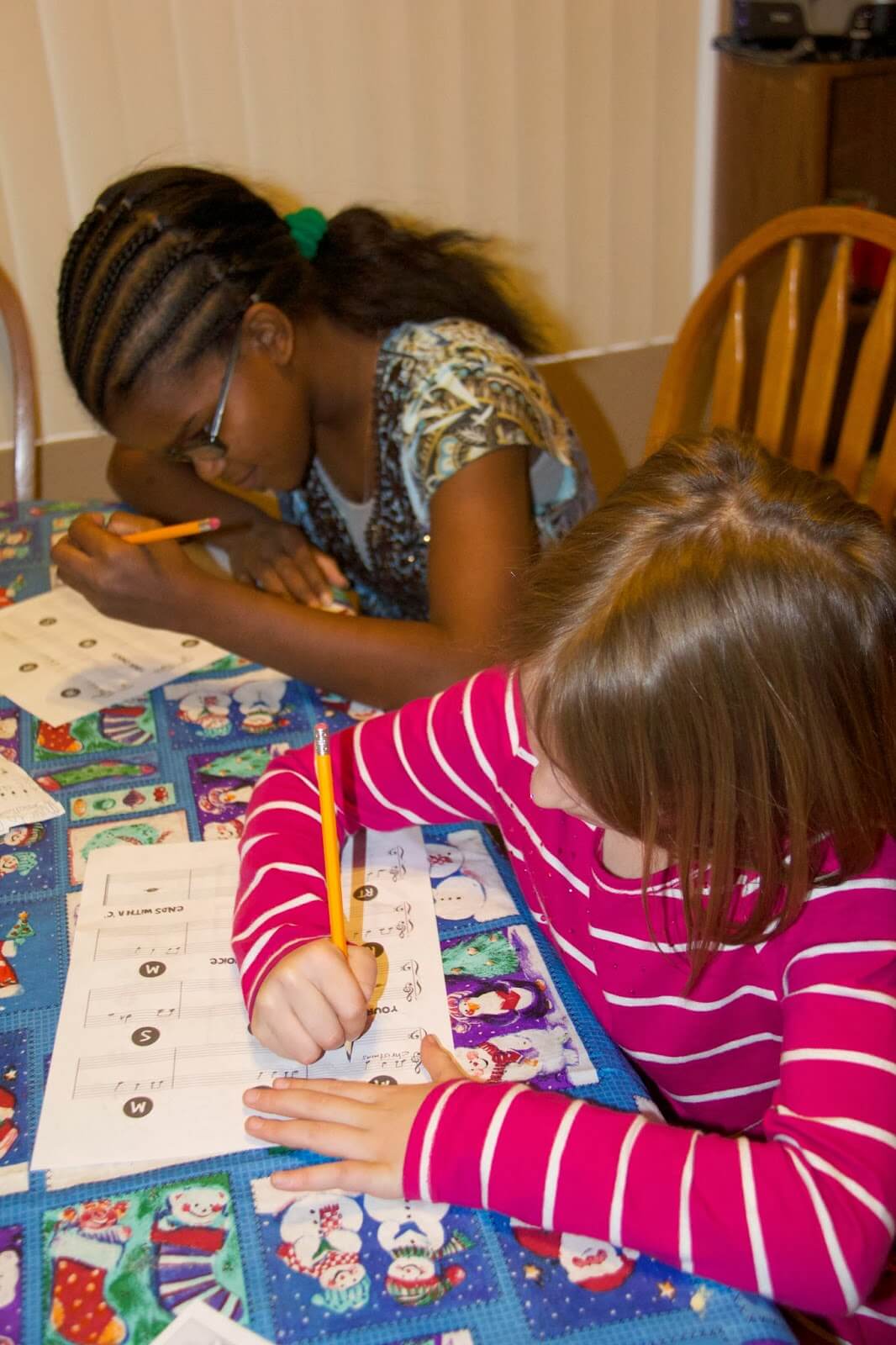
In this review, I wanted to share a little more in depth, my experience using The Curious Case of Muttzart and Ratmaninoff. I knew one of my main focuses for Christmas camp was going to be composition and I knew that I wanted to use this book. One thing that I really love about most of the Dow’s products is that they are offered digitally. Because I did have teenagers participating in christmas camp, and to save money and time, I opted not to print out the entire workbook for each student and instead printed individual pages that were relevant to what I wanted to accomplish during camp. When teaching the composition lesson, I simply downloaded the book on my iPad and projected those pages I wanted students to see and learn on the wall. Once I felt they understood the 4 main composition tools I wanted them to learn and apply, then I turned it over to them to do the fun part- compose!
At camp, I had a couple students that were new to piano lessons and hadn’t learned notes on the staff yet. So for those students I simply had them write in the letter names and dashes (representing rhythm) instead. But the process we went through was the same as the students that did write on the staff.
At camp, we did not worry about adding the left hand. I explained to students that they can add that later at home because we simply did not have time to do this during Christmas camp. So that is something I look forward to seeing and/or helping with when they return in January.
The main tools that are taught in The Curious Case of Muttzart and Ratmaninoff is Motive, Repetition, Sequence and Retrograde. After we went through these tools, one of my students said, “I had no idea that there were actual tools that you can use when creating a composition.” I laughed and said, isn’t it great? Doesn’t it make writing a composition that much easier? This is important especially for students who are so worried that they can’t compose.
Every single one of the students walked away from camp with a finished (RH only) composition. I had one student that even wrote words for hers.



I have used several composition products over the years and I can honestly say that The Curious Case of Muttzart and Ratmaninoff has become a favorite of mine to use! Not only does it add fun with the character dialogs throughout the book, but it makes the whole process easy! The great thing about this book is you can use it successfully in private and group settings. Muttzart and Ratmaninoff interact throughout and make it fun and enjoyable for the student. Composing with The Curious Case of Muttzart and Ratmaninoff is an adventure your students will not want to miss!
You can find out more about The Curious Case of Muttzart and Ratmaninoff by clicking any of the links in this post and watching the video above.
Be sure to ‘Like’ Music Educator Resources on Facebook and follow Music Educator Resources on TpT to stay up to date on giveaways, discounts, reviews and other music resources! And don’t forget to join the exclusive email newsletter!


46 Responses
I love to compose with my students. I have used several composition aids including Lee Evans but there is so much effort and intellect involved. I am using the Dows Santa composition pages this week and we are having a lot of fun. The kids are amazed how their motifs sound. I have been thinking about getting their composition work book and this would give us the chance to try it out! Spring semester is when we compose the most so this would be perfect timing!
This looks like such a fun way to teach composition. It might even inspire students who feel they are not creative or imaginative enough. I would love to win a copy!
Thanks so much for the PIANO PRONTO method book and the Christmas duet. Love reading your updates and all the support you give to music teachers! Jeannie
Date: Thu, 19 Dec 2013 22:33:15 +0000 To: rjmyers@live.com
I have done a few simple composition activities with my students and would love to have a copy of “The Curious Case of Muttzart and Ratmaninoff.” I am having my students do Andrea’s and Trevor’s Christmas composition exercise over the holiday break!
I really enjoyed hearing how you used this, and getting some great ideas for implementing it.
The idea of teaching composition from the early stages totally fits my approach as a teacher and as a therapist. “The Curious Case of Muttzart and Ratmaninoff” seems like a great way to get youth to buy in. Offering this through our local arts commission is an idea I have for this summer.
I’ve been teaching those compostion concepts – repetition, sequence, inversion, and retrograde – as part of composition units, as well as camps, workshops, etc, for lots of years, but think I’m going to get the book and try it. It would be fun to try it with the cute story & fun characters. Love getting ideas from super teachers!
We have a new piano lab and so far we have primarily used composition exercises in different 5-finger positions. Students add notes to a given rhythm pattern and we have used this to study cadences. This book sounds like it would be a great resource – especially appealing to our all-boy class! Thanks for the review.
I wouldn’t go so far as to say I “teach” composition in my studio–I’m not a composer myself, and certainly wouldn’t market myself as such. I do incorporate composition as a supplement, though! I love all of the Dows’ resources, and would love to use The Curious Case of Muttzart and Ratmaninoff in my studio!
I use Composition tool box with my students. I am interested to get a copy of the book and try out with my students
I have several students who are interested in composition and have been looking for a fun way to teach it. Not being a composer myself, it would be nice to have the material spelled out for me to help guide! I’d love to win the copy.
I have the students who are interested in composing take a familiar tune and have them notate the melody by ear to get started with learning how to format and write music. Then we go over how to choose chords and how to arrange them. Or if they are young and can’t stop playing a melody during piano lessons when they are supposed to be listening, I might have them write it down and we’ll finish it later. I’ve been wanting to try this resource, too. Looks great!
I have been very excited about the possibilities for this book since it was released. I do not currently teach composition in my studio, but look forward to having the opportunity to do so when I return from maternity leave this spring.
I used Carol Klose’s “Creative Composition” book this past summer with my students, and then they played their own compositions in a casual recital. (in the park, on my keyboard, followed by me treating them to ice cream at the local Dairy Mart) Lots of fun!
I think this is a wonderful resource to have in a piano studio which is creative and fun . I like the students to do more composing and would love to have this ! Thank you for the opportunity.
I never have taught composition before — didn’t really feel I had the skills needed. But, this past week, I used a resource they made available in their 12 Days of Christmas giveaways to help each of my students “compose” a piece. The kids enjoyed it, and I did too. I’d love to win this to make composition a bigger part of my lessons. Thanks, and Merry Christmas!
I just started teaching my students how to compose and they love it! I first have them notate familiar melodies to get used to writing out notes and so we can discuss chord progressions. Then I have them try to write out their own chord progression pattern. Once they like it, we add a melody over it. I would love to win a free book because I’ve been wanting to buy this one!
Thanks for sharing about this resource. I like to offer new composers poems, pictures, or descriptive titles to choose from for inspiration. Then we explore creating an illustration through sound.
I have only recently begun to teach composition and this is one book I have been looking at. It would be awesome to be a winner in this drawing!
I’ve taught some composing (Music by Me, Susan Paradis) along the way. This looks like a wonderful tool to demystify composing in an engaging process.