

I have been anxiously waiting to use and review The Curious Case of Muttzart and Ratmaninoff, a composition workbook for students created by Andrea and Trevor Dow by TeachPianoToday.com. While it says it is for ages 7-11 the concepts that are taught are really great for all students. I think the age range is mostly due to the fact that it is based on a fun storyline and these cute cartoon characters Muttzart and Ratmaninoff who interact through the composing process.
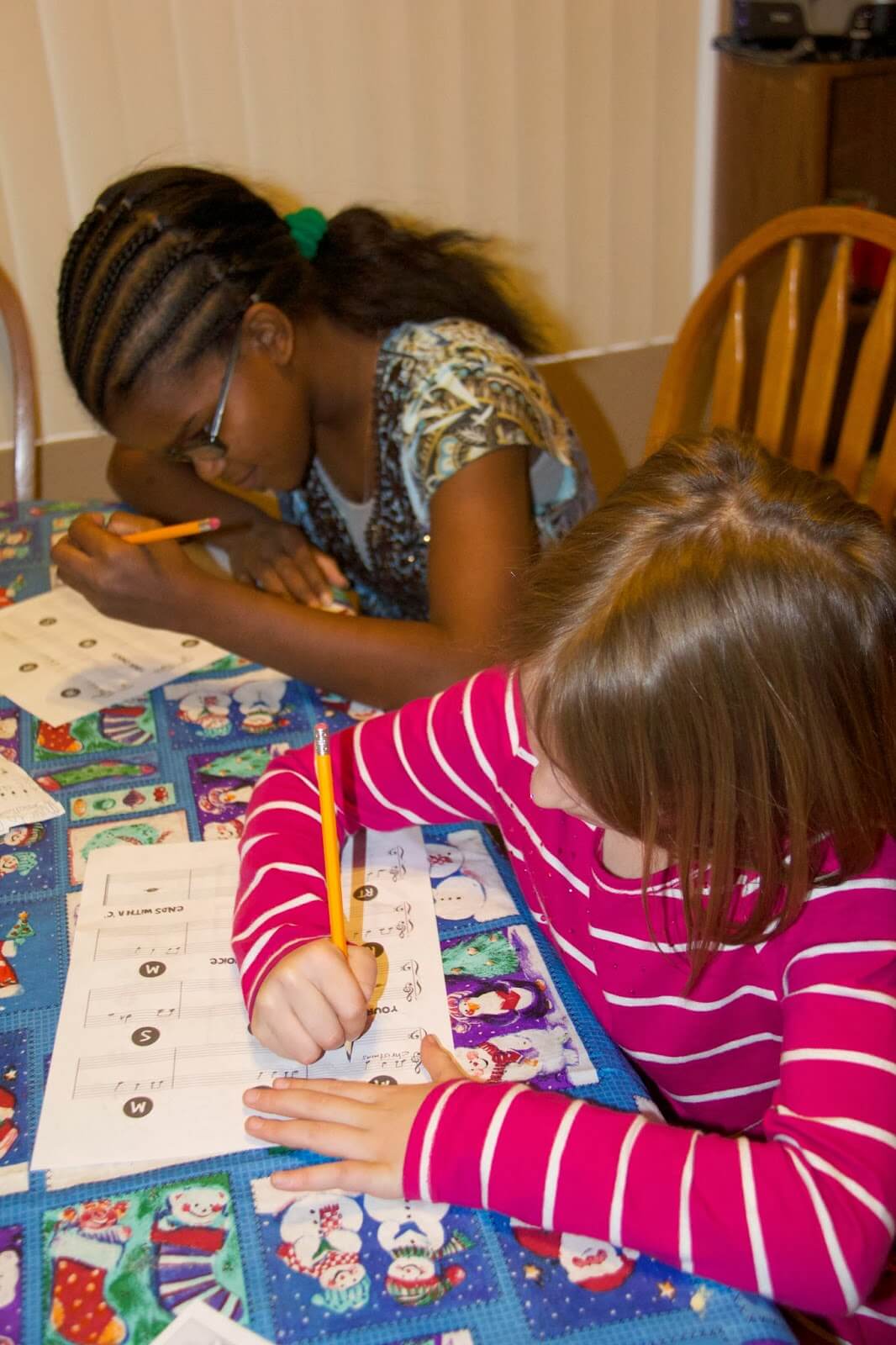
In this review, I wanted to share a little more in depth, my experience using The Curious Case of Muttzart and Ratmaninoff. I knew one of my main focuses for Christmas camp was going to be composition and I knew that I wanted to use this book. One thing that I really love about most of the Dow’s products is that they are offered digitally. Because I did have teenagers participating in christmas camp, and to save money and time, I opted not to print out the entire workbook for each student and instead printed individual pages that were relevant to what I wanted to accomplish during camp. When teaching the composition lesson, I simply downloaded the book on my iPad and projected those pages I wanted students to see and learn on the wall. Once I felt they understood the 4 main composition tools I wanted them to learn and apply, then I turned it over to them to do the fun part- compose!
At camp, I had a couple students that were new to piano lessons and hadn’t learned notes on the staff yet. So for those students I simply had them write in the letter names and dashes (representing rhythm) instead. But the process we went through was the same as the students that did write on the staff.
At camp, we did not worry about adding the left hand. I explained to students that they can add that later at home because we simply did not have time to do this during Christmas camp. So that is something I look forward to seeing and/or helping with when they return in January.
The main tools that are taught in The Curious Case of Muttzart and Ratmaninoff is Motive, Repetition, Sequence and Retrograde. After we went through these tools, one of my students said, “I had no idea that there were actual tools that you can use when creating a composition.” I laughed and said, isn’t it great? Doesn’t it make writing a composition that much easier? This is important especially for students who are so worried that they can’t compose.
Every single one of the students walked away from camp with a finished (RH only) composition. I had one student that even wrote words for hers.



I have used several composition products over the years and I can honestly say that The Curious Case of Muttzart and Ratmaninoff has become a favorite of mine to use! Not only does it add fun with the character dialogs throughout the book, but it makes the whole process easy! The great thing about this book is you can use it successfully in private and group settings. Muttzart and Ratmaninoff interact throughout and make it fun and enjoyable for the student. Composing with The Curious Case of Muttzart and Ratmaninoff is an adventure your students will not want to miss!
You can find out more about The Curious Case of Muttzart and Ratmaninoff by clicking any of the links in this post and watching the video above.
Be sure to ‘Like’ Music Educator Resources on Facebook and follow Music Educator Resources on TpT to stay up to date on giveaways, discounts, reviews and other music resources! And don’t forget to join the exclusive email newsletter!


46 Responses
I’ve been wanting this since it came out and would love to win a copy!
I did a composition music camp this past summer using Joy Morin’s ideas from her “So, You Want To Be A Composer?” camp. This spring I would also like to try the Psalms Project that Natalie does with her students each year.
I’ve only done as much composition as is in the method books that I use. I would like to teach more composing and in a funner way; have been eyeing this book for some time. Hope I win!
I’ve done a little composing with my students but would love to do more and this looks like the perfect tool for doing so. Thanks for the chance to win a copy.
Thanks for the review. I have been contemplating getting this resource. I would love to win it! I have tried composing with my students by making up my own worksheets and doing it step by step. My students love writing their own songs and I would like fun ideas.
I have student composition books that introduce the same four composition tools: motive, repetition, retrograde and inversion but in a very dry boring way. I would love to have an updated and fun way to present these concepts in my studio!
I used this book for summer camp last June and July. Kids loved it! I had the ‘lesson plan’ enlarged and pick on lime green poster board and only printed out the work sheet for the kids. Worked great! Got a couple of new students.
prior message — I had the lesson plan enlarged and PUT on lime green poster board not ‘pick’
Guess it’s been a long day.
I’m still afraid of teaching composition, feeling very inadequately prepared in terms of “know-how”. Your review of Muttzart and Ratmaninoff gives me courage. Thanks for offering the Give-away.
I just got through using TPT’s cute Santa composition activity with younger students this week. I would love to win this resource!
I usually try to incorporate composition into my summer lesson plans. I would love to have a fun resource for the elementary kids. This looks like a great way to approach composition in a fun way. Thanks for the review! I would love to win a copy.
I have not done much with composition and would love to use this book to make the process more clear and easier for my students. I would love to win a copy!
I teach MYC and part of the curriculum includes teaching the kids to compose. Most kids enter the international Composition Festival in February each year , so there is considerable interest in composing. However I am finding myself getting a bit tired of the old way of teaching composition, so this year I used art, poems, themes, etc to help them get going. The Curious case of Muttzart and Ratmaninoff would really help to infuse more creativity into the teaching of composition process and hopefully lots of excitement in the kids to compose more and more ! I would love to win a copy – Thanks for the give-away !
Thanks for offering this give-away! I usually have beginners make up their own short songs for the seasons.
Would love to win. Have been thinking about purchasing. Fun way to teach in group class or my summer camp,
I also teach MYC & have my students enter a Composition Festival. I teach the basic techniques of motive, sequence, retrograde, inversion, fragmentation… but it would be nice to freshen it up!
I do teach composition, and have often utilized Wynn-Anne Rossi’s Creative Composition Toolbox series. I love it because each composition has a concept to focus on, and students seem to really like it, too!
I was all set to start composition after the Christmas idea and my first Monday student crushed my spirits by commenting, “oh my last teacher did that and I didn’t like it.” I had trepidations as it was – how was I going to do this since I had never done it before? Should I make all my students do it or just those who are enthused by the idea? I need a very hands-holding method!
I have done a bit, but know I need to do more composing with my students. What a fun, excellent resource!
Just recently started teaching composition. Thanks for the ideas!
What a great idea to use this for camp!