

*Affiliate links included.
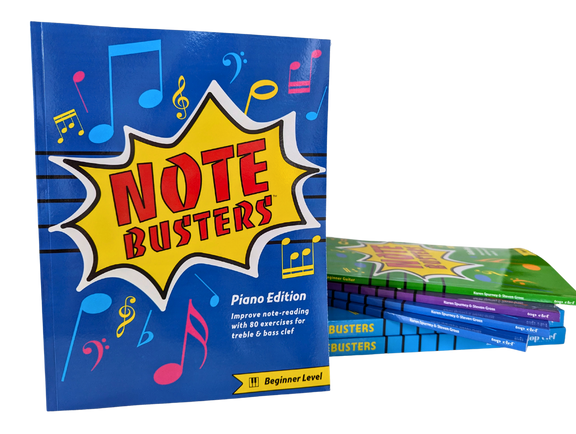
Do you have students in your studio that struggle with note reading? 10 years ago I reviewed NoteBusters, The Complete Edition. I wanted to update my review and include the new NoteBuster books!
NoteBusters, created by Karen Spurney and Steven Gross, is filled with quick one-minute exercises for students. NoteBusters includes not only The Complete Edition, but now you can find the Beginner Piano, Beginner Guitar and Beginner Violin editions. Steven shared with me, “the new books are tailored to specific instruments and ensures the most important notes are locked in.”
Beginner Piano Edition

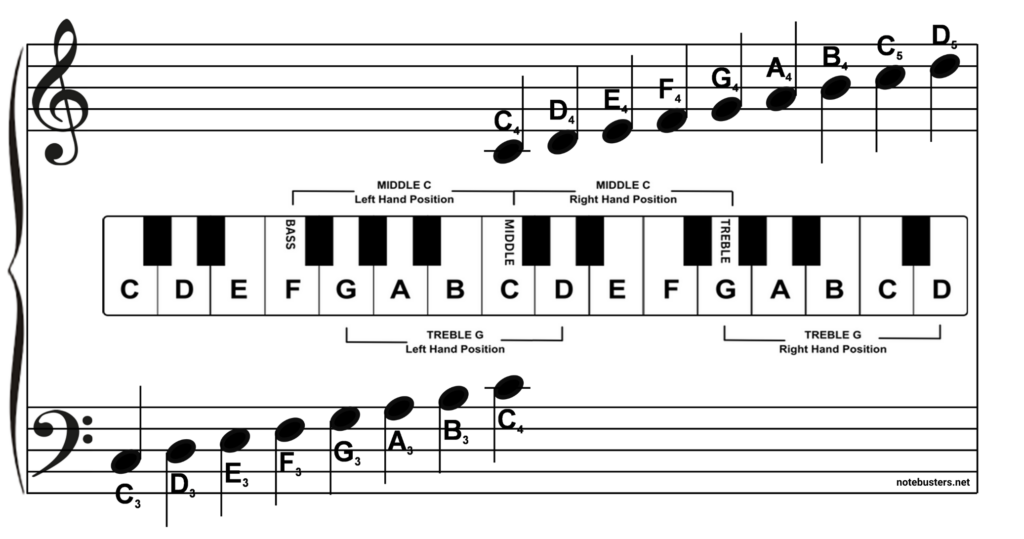
The beginner piano edition covers 9 treble and 8 bass staff notes which would include middle C to treble D and bass C to middle C. These notes would cover students who are learning C position, middle C position and G position (not low G position).
The beginner piano edition contains 25 notes for students to name. It is divided into 4 sections.
- Section 1: Treble, On Staff- includes 7 notes.
- Section 2: Treble, On and Off-Staff adds 2 new notes.
- Section 3: Bass, On Staff includes 6 new notes.
- Section 4: Bass, On and Off-Staff adds 2 new notes.
After completing 5 exercises, students are encouraged to play the notes from that days exercise. When students complete the entire workbook, they will have identified 2,000 notes!
If you teach guitar or violin, you may be interested in the Beginner Guitar and Beginner Violin editions.
The Complete Edition
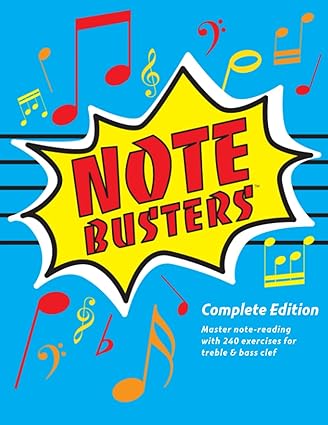
The note drill exercises in The Complete Edition cover more than 30 notes on the grand staff.The cover page is bright and fun and the inside layout is very clean and organized. It is divided into 6 sections, adding more notes on the grand staff to drill. As explained on the website, “The first three sections cover notes that appear on the treble, bass, and grand staves. The final three sections cover notes both on and off the staff (ledger line notes). Each one-minute exercise contains 20–24 notes for the student to identify.” Included in the back of NoteBusters is an answer sheet for students to check their answers on their own.
Scroll through the sample slideshow pages below…


The great thing about NoteBusters is it can be used however you need and would like to use it. Want to use just one exercise each week? Or maybe as a class in a group setting? Maybe you want to drill several pages at a time? During lab stations or center activities? Perhaps you would like a resource for a little friendly note-reading competition? Regardless of what your goal is for a student, it can be done.
There is something to be said about repetition. By the time a student is done with NoteBusters they will have BUSTED their note reading problem away.
If you want to learn more about NoteBusters, check them out on their website.
Disclaimer: I received a review copy of the Complete edition and Piano edition in exchange for my honest review. I was not required to write a positive review nor was I compensated in any other way. All opinions I have expressed are my own.
Enter the Giveaway!
If you win, you can choose between the Beginner Piano, Beginner Guitar or Beginner Violin edition.
53 Responses
great resource
Use flash cards, games, computer games, and apps.
My students and I trade roles of asking pitch names on the staff and finding them on the keyboard, also using the mnemonics for learning line and space notes…quick learn for some and not for others. The more resources the better – thanks!
I do a one minute flash card game at the end of a lesson. The student tries to better his or her own score(number of flash cards correct in one min) each time we do it. If successful, they earn a small reward. Students are not in competition with each other, but with themselves. Would love a copy of this resource!
I use flashcards, worksheets, the Piano Is Fun pc game and many other note reading games that other teachers have shared in various blogs and websites. The kids don’t mind the repetition so much when there are many different approaches to learning the notes.
I have my students sight read at most every lesson. They especially like it when I reward them with a goldfish cracker for each correct note played!
I use flashcards, games, sightreading, worksheets and all sorts of different things.
I have been using flash cards, note spelling sheets, in class games, etc. This looks like it would be a fabulous addition!
This week we are playing “Bats and Cats Notes” by Susanparadis.com 🙂
We use flash cards and class games. Note Busters looks to be versatile and fun! Thanks for all you do to help teachers and students!