
*Affiliate links included.
Do you have students in your studio that struggle with note reading? 10 years ago I reviewed NoteBusters, The Complete Edition. I wanted to update my review and include the new NoteBuster books!
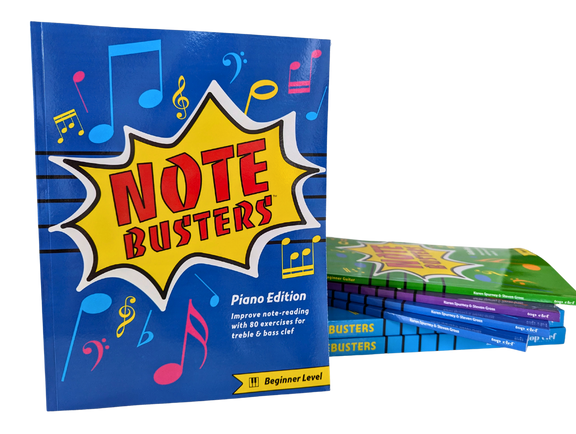
NoteBusters, created by Karen Spurney and Steven Gross, is filled with quick one-minute exercises for students. NoteBusters includes not only The Complete Edition, but now you can find the Beginner Piano, Beginner Guitar and Beginner Violin editions. Steven shared with me, “the new books are tailored to specific instruments and ensures the most important notes are locked in.”
Beginner Piano Edition

The beginner piano edition covers 9 treble and 8 bass staff notes which would include middle C to treble D and bass C to middle C. These notes would cover students who are learning C position, middle C position and G position (not low G position).
The beginner piano edition contains 25 notes for students to name. It is divided into 4 sections.
- Section 1: Treble, On Staff- includes 7 notes.
- Section 2: Treble, On and Off-Staff adds 2 new notes.
- Section 3: Bass, On Staff includes 6 new notes.
- Section 4: Bass, On and Off-Staff adds 2 new notes.
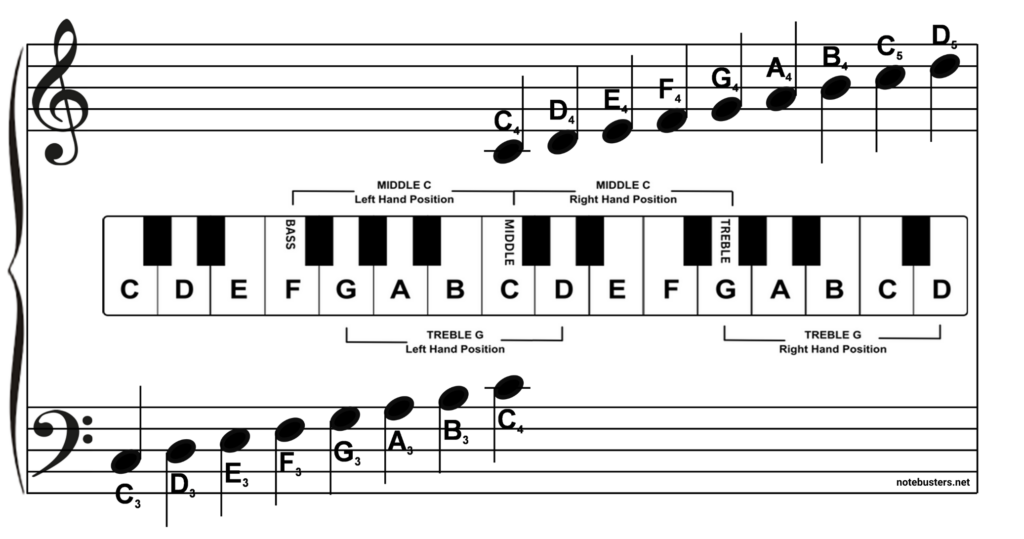
After completing 5 exercises, students are encouraged to play the notes from that days exercise. When students complete the entire workbook, they will have identified 2,000 notes!
If you teach guitar or violin, you may be interested in the Beginner Guitar and Beginner Violin editions.
The Complete Edition
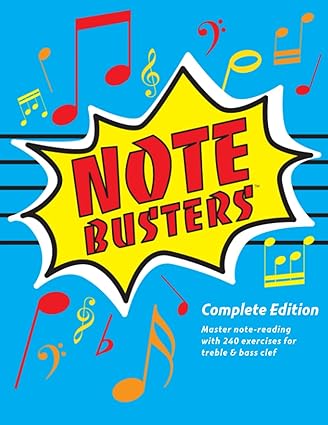
The note drill exercises in The Complete Edition cover more than 30 notes on the grand staff.The cover page is bright and fun and the inside layout is very clean and organized. It is divided into 6 sections, adding more notes on the grand staff to drill. As explained on the website, “The first three sections cover notes that appear on the treble, bass, and grand staves. The final three sections cover notes both on and off the staff (ledger line notes). Each one-minute exercise contains 20–24 notes for the student to identify.” Included in the back of NoteBusters is an answer sheet for students to check their answers on their own.
Scroll through the sample slideshow pages below…


The great thing about NoteBusters is it can be used however you need and would like to use it. Want to use just one exercise each week? Or maybe as a class in a group setting? Maybe you want to drill several pages at a time? During lab stations or center activities? Perhaps you would like a resource for a little friendly note-reading competition? Regardless of what your goal is for a student, it can be done.
There is something to be said about repetition. By the time a student is done with NoteBusters they will have BUSTED their note reading problem away.
If you want to learn more about NoteBusters, check them out on their website.
Disclaimer: I received a review copy of the Complete edition and Piano edition in exchange for my honest review. I was not required to write a positive review nor was I compensated in any other way. All opinions I have expressed are my own.
Enter the Giveaway!
If you win, you can choose between the Beginner Piano, Beginner Guitar or Beginner Violin edition.
53 Responses
I use a combination of apps, flashcards and the Bastien “Dot-To-Dot Notespellers” to help my students learn their notes. Repetition and keeping it fun is the key.
We do the One Minute Club in my studio and I also let the kids play Flashnote Derby on my ipod touch while they are waiting for siblings to finish lessons. It has helped, but I am seeking extra worksheets we can add to their binders for study at home and quickly at the end of their lessons.
I use a book called Perfect Start and constant review!!
So far I have done games and activities I found online but I am always looking for new ways to reinforce notes since my students are all beginners.
Different timed activities with flashcards (one note on a grand staff) is my go to stand by. I also really like Flashnote Derby app. Sometimes I use Joyce Lundeen’s Mr. Bass Clef Note Reading for “say and plays”.
I have a middle school child that is having the most difficult time memorizing the notes on the staff. He has some special needs and we have been working on the notes in middle c position for a year. Every week we play games ( note bingo, etc.) and go over how guide notes can help us locate notes on the staff. Nothing seems to stick so this book would be a blessing. 🙂
I use flashcards and the student says the note then places a gemstone on the correct key. I also have a 1-minute club. I have a transfer student who insists on saying all cows eat grass and all of those sayings. It has been difficult to break this habit and it slows her learning down considerably. Any ideas would be appreciated.
We drill landmark notes!
Looks like a great tool for the studio! We drill landmark notes, use music wrap ups, worksheets, flash cards, and iPad note reading games.
I use flashcards and a series of fun apps with games. I keep looking for new material, so this one is a good choice! 🙂
Drill landmark notes and flashcards. This looks like a great resource!
I use a combination of note drills- 1 minute club — worksheets & sight reading to work on note reading skills.
I would live to wins copy of NoteBusters To add to my list !!
We drill landmark notes, use flashcards, play my note games, board games, etc. We also use the Be a Star books series which has music based on intervals and patterns along with Diane Hidy’s sight reading cards.
I use my magnet board a lot when introducing staff reading. Also refer to landmark notes frequently. I also use a variety of iPad apps, worksheets, flash cards,..whatever it takes!
I use a combination of things, but my students’ favorite is the penny game. I set a timer for 20 sections and pay the student 1 penny for every flashcard note he can identify during that time. Even my older students think they should get pennies!
That would be 20 seconds. I need to proofread before hitting “enter.”
I love this idea! I have a student I’m going to try this with tomorrow! Thanks for sharing!
I love doing smartie note drills (name and play) and mad minute sheets….this would be a great addition to my studio!
I use a combination of the minute club and having them practice sight reading every day.
I customize drills for them at MusicTheory.net.
I usually print off worksheets and use flash cards for drill practice. I have a student right now, who despite every effort just does not seem to get it. Very frustrating all around, I think a resource like this would add to my arsenal!
Sent from my iPhone
I use a variety of resources but emphasize landmark notes and reading intervallically. One of my students’ favorite games is the “Amazing Keyboard Race” in which they race a glass gemstone across the keyboard while answering flashcards.